Tuesday, December 27, 2016

Nopalito Review

Nopalito: A Mexican Kitchen. Gonzalo Guzmán and Stacy Adimando. 2017. Ten Speed Press. 256 pages.

Rating: 5/5

Disclaimer: I received a free ecopy via NetGalley in exchange for an honest review.

I love Mexican food. This hasn't always been the case. I feel like this book showcases a lot of what has drawn me into the cuisine over time. There are a lot of bold flavors and simple recipes that taste great.

Guzmán clearly loves this cuisine and wants to share that love with others. He shares stories about how he grew up around food and which dishes are his favorites. There is a bit of leeway with these recipes too. They might be presented one way with notes about how he has changed the recipes to fit the region he is cooking in.

The best part about it is that all of the recipes are clearly authentic. This starts with instructions on making tortillas at home, an overview of commonly used peppers (fresh and dried), and branching out from the expected Mexican dishes. He draws from recipes found throughout Mexico, so it is not simply a regional cookbook. I found this more interesting because it shows off how varied the ingredients and tastes can be.

I've only read a couple other Mexican cookbooks before, but I would place one at the top of the pile. It has so much that can be useful to beginning and experienced cooks, and presents it in a way that did not feel intimidating at all.

Thursday, December 22, 2016

FUBAR: By the Sword Review

FUBAR: By the Sword. Jeff McComsey, Steve Becker, Chuck Dixon, and Jeff McClelland. 2015. Alterna. 296 pages.

Rating: 4/5

Disclaimer: I received a free copy via Goodreads Giveaways in exchange for an honest review.

There are tons of zombies in this book. The creators reimagined various historical events (i.e. wars) that feature zombies. Some of them I was able to pick out what they were related to immediately, while others were more elusive. At first I was a little uncertain how this would play out because it seems like a riff on adding supernatural creatures to certain novels. The gamble paid off though.

Most of the stories are pretty short. There isn't a huge investment in any of them so a weaker story doesn't drag the whole book down. The art is great though. Again, some of it is stronger than others, but for the most part it is really good. I particularly enjoyed the illustrations connected to medieval Japan. It would have been nice if the stories gave some more information to clue the reader into where and when the story is set. Some of the stories felt generic because they lacked this sort of detail.

It's definitely worth reading for fans of zombie and alternative histories.

Monday, December 19, 2016

Thrud the Barbarian Review

Thrud the Barbarian. Carl Critchlow. 2013. Titan Comics. 110 pages.

Rating: 3/5

Here's what you need to know: Thrud has a small head, he likes beer, and his approach to every situation is to smash things. The book has a rather silly premise. Every one of the stories could stand alone. I think they work pretty well together.

I'll start by saying that the art is the highlight of this series. Aside from some glaring anatomical disparities, it is fantastic. The style reminds me of Mike Mignola's art, but this originally came out about 10 years earlier. It's worth checking out for the art alone.

The stories are pretty simple. Thrud is trying to enjoy some beer and either someone spills it or he runs out. Whatever the case may be, he is motivated to fight the person who spilled his beer or go on an adventure to obtain more beer. The tales go through a range of locations and enemies for Thrud to fight. They just aren't different enough from each other for my taste.

I received this as part of the November 2016 Comic Bento box.

Sunday, December 18, 2016

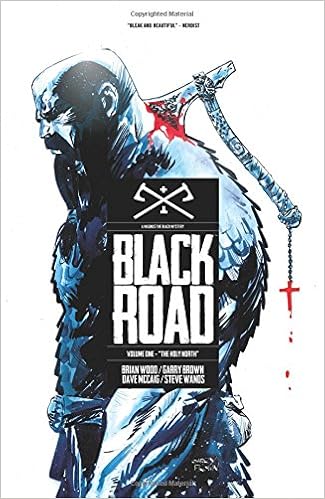
Black Road Volume 1 Review

Black Road, Volume 1: The Holy North. Brian Wood, Garry Brown, and Dave McCaig. 2016. Image Comics. 136 pages.

Rating: 3/5

I really wanted to like this book. I've read some previous stuff from Brian Wood that was fantastic, and the premise seemed interesting. However, the implementation just wasn't up to my expectations.

So the story is about a man in England known as Magnus the Black. He does odd jobs to get by, which include protecting members of the Christian church as they expand their influence in England. A member of the Vatican is killed under his care and he becomes a hunted man.

Magnus straddles the realm between pagans and Christians in this story. This lets him be a guide to the reader into the series, but his indifference left him a little wanting as a character. By the time the story explains how he got to this point as a wanderer I didn't much care about his background. It could have made him a bit more likeable, yet it might do the opposite. He's more of an antihero without the charisma. The side characters round things out a bit, but not enough to want me to keep reading. Some parts of the story didn't mesh well with the others. It made it feel less cohesive than it could have.

The art is really good. It is quite dark, which matches the story fantastically. Something brighter just would not have fit as well. There were aspects of the art that I didn't care for, particularly the shading over the character faces. It strays a little toward the abstract in the art, but not enough for it to be real noticeable.

Friday, December 16, 2016

Bloodshot Reborn Deluxe Edition Review

Bloodshot Reborn: Deluxe Edition, Book 1. Jeff Lemire, Mico Suayan, Butch Guice, Lewis Larosa, David Baron, and Brian Reber. 2016. Valiant Entertainment. 352 pages.

Rating: 5/5

Disclaimer: I received a free ecopy via NetGalley in exchange for an honest review.

Holy crap. I've never read a Bloodshot comic before, although he has appeared in some other Valiant titles that I've read. This book covers three arcs in the character's story, and it is amazing. Not being too familiar with the character, I felt like this was very friendly to new readers.

It gives a brief introduction to the character: he is a super soldier that was implanted with nanites to give him increased strength, speed, and healing. He also doesn't know who exactly he is. During a recent event those nanites were removed from his system. Now he is trying to deal with the aftermath of that event and what it means to be normal again.

Given the character's background, it's not surprising that there is a bit of action in this book. The story builds slowly to that action though. I like that there is some balance between the action and character development. It gives him a chance to grow and create relationships with other characters, even if some of those are only in his head.

I mentioned this covers three arcs. The first is about Bloodshot trying to find himself. It leads directly into the second arc in which he wraps up some loose ends. The third arc is way different from the other two though. It jumps between present day and 30 years in the future. The setting in the future reminded me of Mad Max: a bit crazy and over the top, but still a lot of fun.

The art is superb. There is a different style for each of the arcs. The art for the first arc is great. When it came to the second arc, it felt like there was a huge change in style. It definitely took some getting used to. The illustrations are so noticeably different between the two. The third arc felt like less of a shift in terms of technique and colors, but the panel layouts are pretty different. The creators make great use of mirroring events between the two time periods.

As a first time Bloodshot reader, this book is great. I highly recommend it. Jeff Lemire's writing and the art team are a top notch combination.

Thursday, December 15, 2016

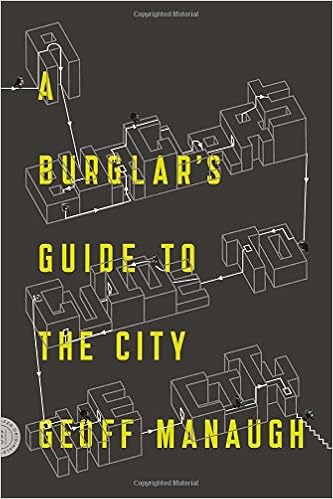
A Burglar's Guide to the City Review

A Burglar's Guide to the City. Geoff Manaugh. 2016. FSG Originals. 304 pages.

Rating: 3/5

I spotted this book while browsing at the library and I couldn't pass it up. The title is just too intriguing. It's really about how criminals use architectural spaces for purposes other than their original intentions. In other words, they don't obey the common rules of how buildings work.

The first few pages drew me in really quickly. The way it was written reminded me of The Devil in the White City, which was fantastic. It veers into a first person narrative filled with anecdotes about the research done for the book and examples of real life crimes. This approach to the subject isn't bad. It just didn't grab me the same way the beginning did. There is a section that gets into legalese about burglary that felt like it went on too long.

I loved the stories peppered throughout the book, whether they were the author's or a burglar's. These spanned a number of topics such as how a city's structure affects crime, the way a building's placement in the city and layout can draw or deter criminals, and tools that are used in burglary. There is a balance between looking at how burglars act and what the police and others do to try to deter burglars.

The author is clearly interested in the subject and put in a lot of time and effort to write this book. However, it was repetitive at times and seemed to be longer than it needed to be. Definitely worth checking out for the ideas presented and the true crime elements.

Monday, December 12, 2016

Emotional Rescue Review

Emotional Rescue: Essays on Love, Loss and Life--With a Soundtrack. Ben Greenman. 2016. Little A. 250 pages.

Rating: 4/5

Disclaimer: I received a free ecopy via Goodreads Giveaways in exchange for an honest review.

As the title indicates, this book is centered around music and how it relates to aspects of our lives. I like the setup for the chapters. Each one starts with a heading page introducing the topic(s), the next page lists music selections the writer associates with the topic, and then there is an essay about it. Sometimes the topics seemed loosely connected to the music selected, although I was not familiar with many of the songs. That didn't stop me from enjoying the writing because the pertinent details of the music are discussed.

I ended up reading this book on my phone, which is the first time I've used it in that capacity. This book lent itself really well to doing so. Each chapter is relatively short, taking about 5 or 6 minutes to read. So it was pretty easy to open it up and read a small chunk when I had an opportunity without dropping out in the middle of a chapter. I could digest it in smaller chunks rather than trying to sit down and read the whole thing in one go. This gave me some time to reflect back on what Greenman was trying to say at times, which may have made it more enjoyable for me.

His writing reminds me a bit of Chuck Klosterman without being quite so cynical. There are times where his stories put me off, but the honesty behind them kept me reading. He talks quite a bit about how he relates to music. It really is about relationships though. Whether it is something that he experienced directly, or just something he noticed through song or from watching others, there is insight here that should resonate with readers. It is a very personal journey and I'm glad to have had a chance to tag along.