Saturday, October 28, 2017

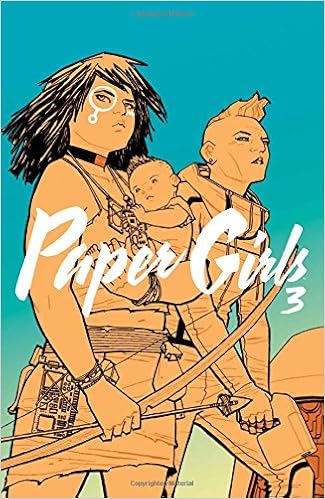
Paper Girls, Vol. 3 Review

Paper Girls, Volume Three. Brian K. Vaughan, Cliff Chang, and Matt Wilson. 2017. Image Comics. 128 pages.

Rating: 4/5

Volume three sees the girls taken from the future of 2016 to the far past. Time travel is a huge element to this series, which anyone that has made it this far along should know. This volume does a great job of pulling together just how pervasive it is in the setting, even if there isn't a lot going on in this arc. It focuses more on the girls, their skills, and their relationships.

After the girls arrive in this new time period, they are confronted by another young woman who acts as a guide for them. Through her, they learn that they aren't the first people to visit this period and that bits of technology have been filtering through rips in space-time. I like that this ties up a loose end from volume two, although it creates more of its own. There is also a character introduced that may be extremely important to the overall structure of the story.

As for the art, I'm still enjoying it. It is just as good here as it was at issue one. The color scheme can be jarring because it is different from what is expected. It uses lighter shades, almost pastel. With the amount of nature in this issue, the colors could have made things weird, but it's reigned in just enough.

This volume lays out some plotlines that could result in a big payoff in the next volume. There is one scene in particular that hints at things to come, which indicates the creators have some long term plans. They need to start giving the readers some more details about what is causing all the time travel trouble and the role of the Paper Girls in all of that. Bring on volume four.

Thursday, October 26, 2017

Superhero Comics Review

Superhero Comics. Chris Gavaler. 2017. Bloomsbury Academic. 376 pages.

Rating: 4/5

Disclaimer: I received a free ecopy via NetGalley in exchange for an honest review.

I'll admit that this book wasn't my favorite. It is very academic, which makes it a bit dry to read. As a result, I took a long time to finish it because I could only read it in small chunks.

There are two major sections of this book: history and analysis. The history portion is quite in depth. It begins by examining adventure books that are a precursor to superhero comics. I've read a couple other books that delve into the history of comics this way and I felt like this one did a good job of not just rehashing what I had read before.

Once it gets into the appearance of comics, it starts to get better. There are a few distinct eras that Gavaler covers. Each one has its own defining characteristics that help to identify them. I think I enjoyed this portion more than the earlier history because I was more familiar with the characters discussed, if not the specific series'. It seemed like there was a diverse choice of characters used, which is nice to show off that this genre of comics can provide readers with more than just white, male heroes.

The best part of the book has to be what I've referred to as analysis. Again, some of what is discussed here has been covered in other books I've read, but the coverage on different artistic techniques that are used and the effects they have is great. I think this book is worth picking up for that alone because it is presented so well. It wraps up with an application of this artistic knowledge to an actual comic, followed by a list of important or influential comics for each era. The book can be a bit heavy at times, but I feel like it has a lot to offer serious comics readers.

Sunday, October 22, 2017

Captain Marvel, Vol. 2 Review

Captain Marvel, Volume Two: Down. Kelly Sue DeConnick, Christopher Sebela, Dexter Soy, and Filipe Andrade. 2013. Marvel. 136 pages.

Rating: 3/5

I picked this up from the library along with volume one and I almost regretted because I didn't enjoy the first book. The story here is better, but goes on a bit too long.

The first part of this book involves a former Captain Marvel, Monica Rambeau, and a giant robot that rises out of the Gulf of Mexico. The relationship between the two women is well done. I don't know anything about Monica though, so I feel like part of their banter loses its impact. The most interesting portion is how it relates to the levees in New Orleans weakening and how the heroes are going to help fix them. Too bad that didn't take up more of the story.

Once that wraps up, Carol returns to New York and is diagnosed with a sickness related to her alien DNA and she is forbidden to fly. This begins to tie things back to volume one. Again, there are characters presented that I'm not familiar with and that aren't introduced very well, so the importance of some of Carol's relationships is lost.

The art splits between a realistic style and a cartoony style. I would have preferred a common style throughout the book. Either one would have been fine. The mix isn't terrible, but it is very noticeable when it does change. There are some cool scenes with the giant robot though.

Amazing Spider-Man, Vol. 1 Review

Amazing Spider-Man, Volume One: The Parker Luck. Dan Slott and Humberto Ramos. 2014. Marvel. 152 pages.

Rating: 2/5

I really like Spider-Man, but this book fell flat for me. I haven't read the preceding Superior Spider-Man series. There are a bunch of references to things that happened in that run, but I don't think it matters much that I haven't read it. This volume is predicated on that fact that Peter Parker has bad luck, so anytime something happens it seems tied to that. It's certainly a theme that's been used in other Spider-Man books, but it feels overdone here.

This book is missing some of the humor that I expect from Spider-Man titles. It tries. Boy, does it try. The attempts don't work out though. And that is tied into the art, which seems inconsistent. Sometimes the character faces and bodies looked normal, and sometimes they seemed distorted or out of proportion.

It's not all bad though. I liked the use of Electro. What happens with his powers, his reaction to it, and Peter's involvement worked well. It might be the most humanizing approach to a villain that I've seen from Marvel in a while. Too bad the rest of this book doesn't compare well to it.

Friday, October 20, 2017

Descender, Vol. 2 Review

Descender, Volume Two: Machine Moon. Jeff Lemire and Dustin Nguyen. 2016. Image Comics. 116 pages.

Rating: 4/5

This book started off a little shaky for me. It had been quite a while since I read volume one, so I had to refamiliarize myself with the characters and what was going on in this setting.

Even though this series seems to be centered around Tim-21, a sentient robot designed to look like a young boy, the parts that stood out in this volume had no direct interactions with him. Andy, who was Tim's owner, learns that the robot is still alive and sets out to find him. He picks up a sidekick along the way. This part of the story is very enjoyable because it starts to fill in some gaps between what happened at the beginning of the series and the present.

The other part of the story featuring the Evil League of Robots (not what they are actually called) could have used some work. It lays some groundwork for what I expect to come in future volumes, particularly when related to Tim-21. There just wasn't a lot to excite me about those portions of the book.

The art is weird and took me some time to get used to. Instead of being very polished and somewhat futuristic looking, as you would expect, it's sparse and almost appears unfinished at times. Once I adapted to it, I decided it works great for this book. There is a nostalgic element for the characters that the art seems to highlight.

Wednesday, October 18, 2017

Star Wars: Kanan, Vol. 1 Review

Star Wars: Kanan, Volume One: The Last Padawan. Greg Weisman, Pepe Larraz, and David Curiel. 2015. Marvel. 144 pages.

Rating: 4/5

Kanan manages to capture the feel of the Star Wars movies without relying on the central characters. The character is connected to the Star Wars Rebels series, which I've never seen so I have no idea how this compares. I do know that I enjoyed this book a lot.

His story picks up near the end of the Clone Wars, when the slaughter of the Jedi is ordered. From there, he is on the run trying to survive in a universe that he is ill prepared for. There is some tension as the clone troopers from his old squad are hunting him down. Kanan has to forget much of his training to make it, even going so far as to throw in with a smuggler. I like that this gets wrapped back into the present day of the other Star Wars comics that Marvel has been putting out.

The art is great. There are so many strange elements in Star Wars, so having this visual medium to convey the story works wonderfully. It makes it so easy to get a sense of the different characters in a very short period of time. This book is exactly what I want from a Star Wars comic because it makes excellent use of the setting and tells a fun story at the same time.

Tuesday, October 17, 2017

Chew, Vol. 7 Review

Chew, Volume Seven: Bad Apples. John Layman and Rob Guillory. 2013. Image. 128 pages.

Rating: 4/5

I took a long break between volumes 6 and 7. The series is still good at this point, but this one isn't quite as funny as the previous books. It does have its moments, but it has a much more serious quality to it. It deals with the aftermath from volume six a lot.

Highlights include the strange egg worshipping cult, Tony standing up for himself, and the couple of moments the creators took to poke fun at the series. Even though I didn't enjoy this volume quite as much as some of the previous ones, I'll definitely pick up more. The setting is great and the characters are solid. I've been a huge fan of the at since book one, so it doesn't disappoint one bit in that regard.